Life and thoughts from a small-scale organic farm . . . and its farmers

This is a blog that explores ideas around the growing of food and community at Glen Valley Organic Farm.

Wednesday, August 25, 2010

Our Harvest Boxes This Week


I haven't been posting the contents of our Harvest Boxes to the blog thus far. Today, however, I'm noting the contents, just because we're at the height of the season and the boxes look incredible.

1 bunch Rainbow Chard
1 bunch Dandelion
1 Romaine Lettuce
1 bunch Dill
1 lb Green Beans
1 bunch Beets
2 Mini-Cabbages
3 lbs Carrots
1 Long English Cucumber
2 Slicer Cucumbers
2 Garlic Bulbs
1.1 lbs Leeks
2 Sweet Onions (one red, one white)
2 Beefsteak Tomatoes
1 bunch Green Onions

We went heavy on the allium family this week; it's the last week for garlic, the leeks and sweet onions are beautiful and a planting of green onions matured this week. This is foreshadowing for the incredible crop of storage onions and shallots we are just beginning to cure for storage. The tomatoes are at their peak and we only wish we could grow more! Cucumbers, beans, carrots and beets remain in abundance.

I'll take a moment to note that since our farm is in the Lower Mainland our boxes are heavy on veggies and lower on fruit. We don't have the consistently high temperatures and cold winters necessary for the popular soft fruit crops that grow in the interior. This is part of understanding the bio-region in which we live and knowing what we can grow in this environment. Field crops (root crops, leafy greens, beans and berries) do well here, tree fruit not so much (although I'm looking forward to some amazing apples from the orchard of heirloom trees in the month ahead).

Our CSA has 33 members this year. We're trying to figure out how to increase the spots available for next year, including working with different social service agencies to get boxes to individuals who otherwise have difficulty accessing fresh produce. Any ideas would be greatly appreciated.

Monday, August 16, 2010

Mid-August farm round-up

Mid-August means the harvest is picking up and the days are still long and hot. Our sunflowers are in full bloom and the bees are busy, as you can see above.

We planted three beds of sunflowers on the edges of our fields this year. They attract beneficial insects and are an incredible sight.

Jeremy has hung garlic to cure in various locations around the farm. One of my favorite views of the farm is from the dairy barn where one batch of garlic is curing. You can see the red roof and vines of a farm residence in front of the pastures and fields below.

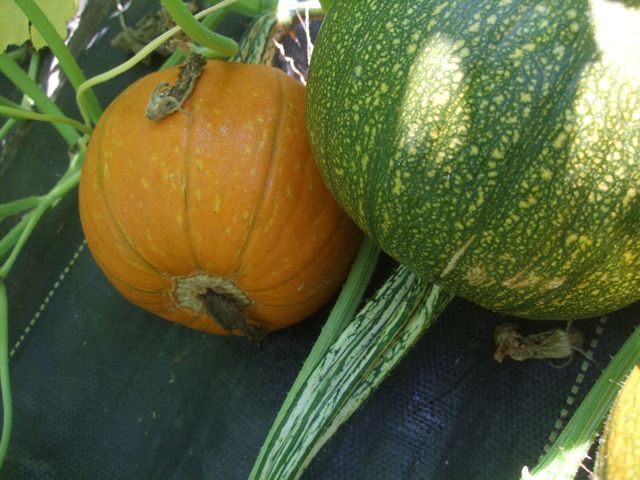
I was happy to spy some of the pumpkins and squash sizing up and even ripening in the fields. Squash are one of my favorite crops, both for their taste and aesthetic in the fall.

A Red Kuri squash is looking pretty nice amidst the vines.

Part of a bed of cilantro has gone to seed, right next to our pickling cucumbers. I was harvesting cucumbers today and heard a hum the entire time -- thousands of bumble bees, honey bees, wasps and various insects all pollinating the flowers. It's absolutely amazing to overhear flower sex!

The Crone's Cottage in our meadow is another good place for curing garlic. You can see that the cottage has quite a lean. It might not be around in its current state for much longer.

For the meantime it makes a great place to cure garlic and butcher goats (to come later in the fall).

That's my photo documentation for the day.

First canning of the season

Last night we did our first canning for the season (apart from some earlier jams). I picked up a case of peaches from The Fruit Guy at the White Rock Farmers Market yesterday (his booth was right next too ours). The peaches had to be used the day of the sale, so we got the canning equipment out and fired up (i.e. turned on) the stove.

We have a large assortment of jars, many of which are from my own grandparents. The jars above came from my Ukrainian-roots grandmother in Saskatchewan, so they've seen everything from dill pickles and sauerkraut to borscht, apples and root beer over the decades.

You'll notice the glass lids, which use a rubber ring for sealing. these haven't been manufactured since the 1950s. Jar companies say these aren't safe for canning because they don't have a moron-proof "snap" lid to indicate that they're sealed (and since you don't have to buy new lids every year to support their companies, they must be unsafe). Instead, you actually have to remove the zinc lids to check if the lid is sealed. And the lids seal so tight that you need a knife or screwdriver to open them up. It's obvious whether or not they're sealed.

We noted that yesterday had to have been the hottest day of the year thus far -- it seems like we only do canning on the hottest days. But no wonder; that's when the produce ripens!

Now we're gearing up for more fruit canning, tomato sauces, salsas and lots of apple sauce. If we're adventuresome enough, we might even try salmon this year. It means many long, hot nights in the kitchen and many great meals through the winter.

So I'm curious . . . do you can? And if so, what do you can? Share your comments below.

Saturday, August 14, 2010

Magic Spaces on the Farm: The Herb Garden

The Herb Garden at Glen Valley Organic Farm

Often we think about magic as something unattainable. Yet there's magic in the world around us everyday. Indeed, our gardens contain some of the greatest magic of all, particularly when it comes to healing and maintaining health. A range of herbs and other plants contain various chemicals that can help us in many ways.

Last summer the farm welcomed Barb as our resident herbalist. Barb arrived from her previous farm, Twobie Creek, along with hundreds of her perennials and a small flock of ducks. Coming the Glen Valley Organic Farm allowed Barb to downsize to an appropriate amount of growing space without the overhead cost of a mortgage.

Now established as Glen Valley Herb and Apothecary, Barb began work on reclaiming a herb garden that had previously existed at the south end of the property, right along the entry to the forest -- high above the rest of the farm. The old herb garden had been more or less abandoned for three years prior to Barb's arrival.

After weeks of blackberry and weed removal, the former splendor of the herb garden began to reappear. Along with a newly constructed shed (and duck home), the herb garden is now in full bloom. Barb is doing regular harvests and drying the herbs to add to her apothecary, although the move between farms means many of her perennials are only getting established this season.

In addition to the herb garden itself, Barb has established her lavender bed in a previously-unused (and weedy) flowerbed at the farm's entrance. She also planted rosebushes (which she harvests flowers from to produce Rose Petal Moisturizer) around the yard in front of the Farm House. Barb also has a coldframe that she uses for starting transplants in the spring and overwintering fragile plants.

Barb in front of her apothecary cupboard

Barb's culinary and medicinal herbs, salves and moisturizers are available at some of our farmers market stands throughout the year.

As a herbalist, Barb knows the medicinal qualities of her herbs. But Barb is also a strong advocate for viewing our entire diet as part of our medicinal routine. Many of our regular culinary herbs also have medicinal properties -- as do many of our foods. Eating a diverse and varied diet and being conscious of potential impacts of certain foods is an important part of preventative medicine.

And that's the magic of our gardens. Much of what we need to stay healthy doesn't come from a bottle. Rather, when the garden is our medicine cabinet we can rest a bit more easily that the natural world around us is a therapeutic place.

Tuesday, August 3, 2010

Home Grown at the Museum of Vancouver

The Museum of Vancouver is hosting an exhibit entitled Home Grown: Local Sustainable Food, from August 26, 2010 through January2, 2011. It features the photography of Brain Harris, including images from our farm.

I'll be doing a tour of the exhibit on 2 September focusing on the topic of The Advantages of Knowing Your Farmer by Buying Locally.

Monday, August 2, 2010

Magic spaces on the farm: The Labyrinth

Jo Wilson in the farm Labyrinth

Glen Valley Organic Farm has many corners and pockets that are best summed up as "magical". I like to imagine that there could be magical beasts that frequent these spaces -- whether trolls, fairies or leprechauns. But mostly they're magical for reasons we can see as well. Some of these spaces are magical because of their natural beauty while others are magical because of what people have done to the spaces.

One of the magical spaces we walk by many times each day is the farm's labyrinth. A small section of land between the farmhouse and barns along Bradner Road, the labyrinth is a magnificent garden bursting with flowers and herbs throughout the summer months.

Started by Brenda Grealis, the Labyrinth has been a labor of love for a long-time member of the farm co-operative, Jo Wilson. Every weekend throughout the summer Jo makes her way to the farm from her home in Burnaby via public transit and her bicycle, arriving on Saturday and leaving early Monday or Tuesday morning.

Jo spends much of her weekends weeding, digging and pruning in the Labyrinth's flower beds as well as a few other flower beds around the main farmyard. This year is the first year that the entire Labyrinth is completed -- all of the beds are finished and maintained.

Walking through the Labyrinth is special in its own right, but Jo's presence makes the space magical. Having become a member of the farm co-operative in order to preserve the farmland and support farmers, Jo has supported Glen Valley Organic Farm since its early days. She regularly works at the farm's stall (as part of Langley Organic Growers) at the Main Street Market in Vancouver. She offers ideas and advice on problems we face at various points. And she helps with gardening at a time when we simply don't have time ourselves to keep the farmyard maintained beyond an occasional grass cutting.

Having a city supporter who takes her involvement with the farm to this level is a significant support to the farm. In particular, her weekend visits help to provide us perspective on the world during the busiest time of the farming year. And by maintaining beautiful gardens, we have both a refuge and an aesthetically appealing space right near our homes.

The Labyrinth has other magical properties. Last night Jo watched a baby hummingbird fly through the flox flowers. Each summer a small patch of blueberry bushes keeps farm residents and visitors well-fed. Small ornaments throughout the garden provide surprises to Labyrinth walkers.

It's a treat to have spaces on the farm that are magical. It's an added bonus that the magic is as much a result of farm personalities as the natural beauty. And maybe there's the odd leprechaun running through the garden too.

Wednesday, July 28, 2010

Scenes from the farm

The farm is in all its splendor at the moment, so here are some images to show what's going on.

The onions are bulbing up. They respond to the shortening daylight. Our crop this year looks much better than the sad harvest of 2009.

We don't enjoy much tree fruit on the farm (apart from the abundance of apples in the fall). Although our peach trees produced no fruit this summer, our plum trees are full. Here is a typical branch of abundance.

It doesn't look like much now, but these beds contain many of our fall and winter crops: cauliflower, cabbages, broccoli and brussels sprouts. You can see the irrigation line and a few small transplants.

This is a view toward the north-west corner of the farm, from the centre-south end (the higher elevation point on the property). You can see the pastures and the crop fields just before the train (that's the CN mainline separating us from the Fraser River). Gorgeous mountains in the distance.

We plant flower belts in our fields to provide habitat to beneficial insects. The flowers include poppies, calendula, bachelor buttons, baby's breath and cosmos - plus more. This mix provides continuous flowering from late-June through the end of the season. Insects attracted include parasitic wasps and ladybugs.

An up-close shot of the flowers in the fields.