 |
| An early morning spider web, back-lit by the rising sun. Photo by Brian Harris |
August tends to be like this on the farm. Regardless of how prepared we think we are, it always comes as a surprise.

|
| An early morning spider web, back-lit by the rising sun. Photo by Brian Harris |

 Barb, on the other hand, sports a sensible bug shirt. These are practical shirts made of netting that makes it difficult for mosquitos to bite. They can be awkward on the face when doing certain tasks, and they don't offer sun protection, but are useful overall. I use a similar shirt for milking and other farm tasks at various points during the day when the sun isn't shining.
 By later in the week, Sean had switched to a bug shirt. He also made a trip into town to purchase white t-shirts (previously, he only owned black).


 The sun and heat finally arrived this week and we have left June-uary behind. the fields are looking much better as green begins to take over the colour scheme. Here are some images of the farm from the past few days. Above, row cover over carrots and parsnips keeps the rust fly out. It also keeps heat and moisture in, helping to accelerate growth. The carrots and parsnips have been weeded this past week. Squash are on the left of the cover, onions on the right.


 The salmonberries are just finishing up. Following them are the thimbleberries and, of course, the actual food crops we grow in our fields.


 The redwing blackbirds nest on our farm, offering a great song and fantastic bug-control functions. I love the redwing blackbird, partly because it's one of the familiar birds from growing up on the prairies.
 The raspberries have formed fruit and will be ready in a couple of weeks.
 Here's an early planting of beans. I'll expect to be harvesting them by the end of the month.
 The Fraser River has been very full for a long period this year. Above is a dyke on 88th, just of 264th in Langley (near our farm). Notice on the farm left that the field is flooded -- the dyke is over capacity and a lot of land on the area along the river here is flooded.
 Our pasture areas are flooded and there are low areas of our vegetable fields we haven't been able to cultivate this season. This is the water level on my boots walking down to the fields through the pasture. All of the water means that it's a brutal year for mosquitos.
At this point in the season, our CSA subscribers and market customers may feel overwhelmed by greens. If you don't cook with Kale, Collards and/or Chard on a regular basis, finding a bunch of at least one of these in your box each week can be intimidating.
Last year we posted a list of ways to use greens. It still has the basics, but here are some more ideas.
The fastest way to prep greens is to chop them into ribbons and steam or saute them. They can be sauteed with onions or garlic (scapes anyone?). Both steamed and sauteed can be served with balsamic vinegar and oil. Lydia, a CSA subscriber suggested this recipe (click on the link) for Collards or Kale with Tahini. Lydia serves this on quinoa for a complete meal.
A classic in our kitchen for using a multitude of veggies in season (and whatever greens we have around) is this salad:
2 cups cooked Quinoa, Millet or Rice
1/2 cup cooked beans or chickpeas
4-6 oz Feta Cheese, cubed
2 tbsp Dulce Flakes or crumbled Kale Chips (see earlier recipe on blog)
2 handfuls steamed Fava Beans (taken out of the pods)
1/2 bunch chopped Parsley
1/2 chopped Cucumber
2 green onions, chopped
1 handful steamed broccoli florettes
1/4 fennel bulb, sliced horizontally into chevrons. See how to slice a fennel bulb here.
Any other veggies you have around: Tomatoes, peppers, etc.
Mix together and serve over a bed of greens (e.g. lettuce, Chopped
chard and kale, etc.) with olive oil and vinegar. It's a light,
filling meal.
(from The Rebar Cookbook)
1 bunch spinach, stemmed
1 bunch cilantro,
1/2 bunch Italian parsley
2 jalapeno peppers, one seeded
1 t salt
2 1/4 vegetable stock
2 T olive oil
1 onion, diced
2 garlic cloves, minced
1 1/2 c long grain rice
1. Carefully wash spinach, cilantro,parsley and jalapenos. Place in a blender with salt and 1 cup of stock. Blend to liquify and set aside.
2. Heat a rice pot at medium-high and add the oil. Heat and add onion with a pinch of salt; saute until translucent. Add the garlic and rice and saute for a few minutes, stirring often, until the rice turns lightly golden. Add the contents of the blender and the remaining stock to the rice; stir well to combine. Turn up th eheat and bring to a boil. Cover, reduce heat to very low and cook for 15 minutes. Turn off heat and let the rice stand covered for 10 minutes. Gently fluff the rice with a fork and serve immediately.
There are many ideas for using chard at Smitten Kitchen
Please share any additional ideas you might have.

 Mid-August means the harvest is picking up and the days are still long and hot. Our sunflowers are in full bloom and the bees are busy, as you can see above.
 We planted three beds of sunflowers on the edges of our fields this year. They attract beneficial insects and are an incredible sight.
 Jeremy has hung garlic to cure in various locations around the farm. One of my favorite views of the farm is from the dairy barn where one batch of garlic is curing. You can see the red roof and vines of a farm residence in front of the pastures and fields below.
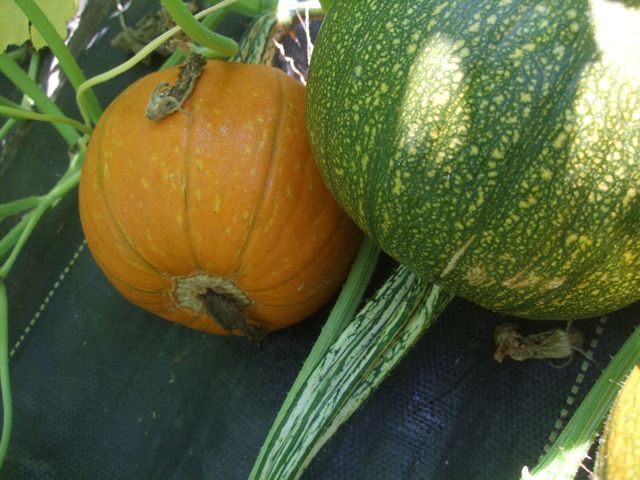 I was happy to spy some of the pumpkins and squash sizing up and even ripening in the fields. Squash are one of my favorite crops, both for their taste and aesthetic in the fall.
 A Red Kuri squash is looking pretty nice amidst the vines.
 Part of a bed of cilantro has gone to seed, right next to our pickling cucumbers. I was harvesting cucumbers today and heard a hum the entire time -- thousands of bumble bees, honey bees, wasps and various insects all pollinating the flowers. It's absolutely amazing to overhear flower sex!
 The Crone's Cottage in our meadow is another good place for curing garlic. You can see that the cottage has quite a lean. It might not be around in its current state for much longer.
 For the meantime it makes a great place to cure garlic and butcher goats (to come later in the fall).
 Last night we did our first canning for the season (apart from some earlier jams). I picked up a case of peaches from The Fruit Guy at the White Rock Farmers Market yesterday (his booth was right next too ours). The peaches had to be used the day of the sale, so we got the canning equipment out and fired up (i.e. turned on) the stove.

