Life and thoughts from a small-scale organic farm . . . and its farmers

This is a blog that explores ideas around the growing of food and community at Glen Valley Organic Farm.
Showing posts with label farmers market. Show all posts

Monday, June 13, 2011

It's better to sell out than throw out

The months of May and much of June can be odd times at the farmers markets, particularly for small farms. It often happens that by the end of the first hour we are sold out of our most prized veggies of the day. It often leaves people to ask, "Why don't you bring more?"

In fact, a few people have taken the time to explain to me the following impacts of us selling out:
  • It reflects poorly on the market when customers arrive and can't find produce;
  • We're only thinking about ourselves and not the people we need to feed (who consequently can't get our produce); and
  • People who have never been to the market before will arrive, find no selection, and never shop at a farmers market again.
Admittedly, most of these comments are offered in the spirit of direction, not of discussion. As a result, I very rarely get a chance to explain the marketing strategy of a small farm at the farmers market. While most of those offering me instruction likely don't read my blog, I will nonetheless take a moment to explain our objectives at the market.

First and foremost, we want to sell out. One of the first things my farmer mentors taught me was that it's better to sell out than to throw out. Some extra produce at the end of the day gets donated to local charities who pick up leftovers at the market. Some goes back to the farm for us to eat. Some ends up on the compost pile. None of it earns us an income. We never like to short customers on orders, but we also have to be realistic about what we can grow considering all factors such as weather and past sales history.

Second, we often don't have more product. As a small farm, we often take what we have. And the market is busy. Yes, we sell out of 144 pints of strawberries in an hour and we couldn't pick more before the market. Of course, if I could bring enough produce to sell everyone exactly what they wanted, I would. But the beauty of the farmers market (for the farmer) is that sometimes I only have a half-case of spinach and I can sell it along with everything else I have that week. The beauty (for the customer) is that the creative chef will be surprised by what arrives on a given week.

Third, produce doesn't keep. When we don't have refrigeration and automated misting machines at the market (a la grocery stores), it makes it difficult to hold produce through a four hour market, especially on a sunny day. Strawberries or raspberries picked ripe won't last. For heat-sensitive produce, we bring what we know we will sell in the cool, early hours of the market. The best farmers markets start early in the day and don't last more than four hours.

Fourth, we plan based on sales of the previous week. When we sell out of chard after the first hour of the market, we increase what we harvest for the following week. We also watch weather forecasts for each market day and have to decide whether sales will increase or decrease because a market falls on a long weekend. If sales of a product were rotten one week and then the same product sells out the following week, we're something left baffled. It's a tough guess at times, but we try to send what we think we can sell.

So, that's a bit of the logic behind the farmers market. Ultimately, we also have to keep in mind that we're one small farm and we can't feed everyone. Rather, we try to support markets and encourage other small farms so that we will have a diversity of farmers at markets, able to meet the needs of our customers' menus. I remain confident that a multitude of small farms can meet much of our society's food needs.

An efficient food system, in my ideal, means little waste and a diversity of growers -- including traditional farmers, urban farmers and gardeners galore. If we can do this by selling and using everything we grow rather than by throwing out surplus produce we're onto a good thing.

Wednesday, November 10, 2010

Changes coming for next season

There are some changes coming to how we market our produce next season. I haven't posted for a while, largely because of time constraints. But I wanted to note an important change.

Beginning in the 2011 season our farm will no longer be part of the Langley Organic Growers marketing co-operative. We decided to step out of this collective of organic farms in an effort to concentrate our sales efforts in fewer venues.

As many of our regular customers know, we have been selling at 9 farmers markets in 2010. Five of these were through Langley Organic Growers (all four Vancouver markets and Coquitlam). The remaining four markets (Lonsdale Quay, White Rock, New Westminster and Langley) are stands we do alone as Glen Valley Organic Farm.

Due to personnel changes on our farm this season, Langley Organic Growers had difficulty staffing all of the markets we were registered to attend. In the meantime, we have just completed the second year of our Community Supported Agriculture Harvest Box program. We have received a number of requests to expand our CSA program next year. As well, we regularly send less produce to some markets in an effort to supply the rest of the markets.

In the past, our marketing co-operative has felt an obligation to attend a new market in order to support its development and provide customers with an organic alternative. Due to a growing number of new, small farms, this is no longer necessary. And due to the growing number of markets, it is no longer possible, either.

We recognize an opportunity to concentrate our efforts on our four markets (possibly one more) plus our CSA in the coming season. Supplying as many markets as we have been doing is no longer sustainable for us in terms of energy and attention. In addition, we see a need to focus some attention on supplying under-served markets, including low-income customers and neighbourhoods outside of Vancouver-proper.

Langley Organic Growers has included Myers Organic Farms, Olers Farm, In Season Farm and Greg Reid Farm and Glen Valley Organic Farm since 2007. Prior to this, Friesen Farm and Glorious Organics were part of Langley Organic Growers while In Season and Greg Reid Farms were not.

Before the 2007 season Friesen Farm and Glorious Organics formed Organic Farm Connection and Langley Organic Growers welcomed In season and Greg Reid Farms. This arrangement benefited all farms by allowing for less congestion at market stalls and greater capacity to supply more customers.

The farms involved in Langley Organic Growers and Organic Farm Connection include some of the original organic farmers in the Lower Mainland. It has been a privilege to work so closely with these experienced farmers during our entry into farming.

This past year has been exciting. More new farmers are coming to markets and this is providing many shoppers with more choice. No one farm or farm co-operative needs to feel an obligation to supply all of the markets.

We know that our departure from Langley Organic Growers will provide the remaining farms with more opportunity to grow crops we have previously supplied. It will also streamline the group's overall operations.

One of the most important lessons we have learned since starting farming is that co-operation is the cornerstone to successful agricultural operations. No one farm or farmer can do everything. The farm community supports each other in times of crisis as well as in regular daily operations. Likewise, the partnerships we have with urban food groups is very strong and provides us with the ability to farm in a small-scale, sustainable fashion.

Our dream for the sector is a future of thousands of small-scale farms practicing sustainable, intensive growing practices and marketing direct-to-consumer and/or co-operatively through a variety of channels. The local food scene is changing rapidly and this dream seems attainable with some hard work and a focus on end goals.

So, with all of this in mind, we don't think of our departure from Langley Organic Growers as an attempt to "go it alone". Rather, we're refocusing and figuring out some next steps in an effort to continue to grow and change in tune with the larger local, organic food movement. We're happy to have so many wonderful people to work with.

Wednesday, September 29, 2010

Watermelons and the Price of Local Food

My two farm hands pose with their melon harvest . . . their new favorite crop.

Melon season arrived on the farm today and melons make me think of money. Prices, more specifically. And I've been thinking about prices and money a lot this week, after a CBC radio host commented on the cost of local, organic food . . . but more on that in a moment. I'm also thinking about watermelons.

The truth is, the melons surprised me. I've been ignoring the melon patch. Nothing else is planted around it, so it's been easy to walk by and not look too closely.

Today, however, we ran out of fruit in the house. And both children were screaming. And Paige (now 8 months pregnant) needed some quiet. It was time for a walk. A trip yielding fruit would be even better.

We ended up in the melon patch. Watermelons were the only conceivable fruit I could think of that might be ready on the farm (apart from apples, of course). In the back of my mind I recalled Jeremy commenting on the fact that melons might be ready for the market this weekend. I didn't think much of it at the time; last year we had melons in mid-August. Beginning of October melons? They couldn't be any good.

Watermelons are a difficult crop, but well worth the effort when they grow well. They need heat, lots of water, weeding and more heat. We started growing melons two years ago as an experiment. When we sent a bunch to market for the first time we had to figure out a price -- we had no precedent.

Once our costs were considered, we figured that we would have to charge the same price we have for our squash -- $1.25/lb. This came as quite a shock to customers who normally pay $0.29/lb for conventional melons in the stores through the summer. After various comments about the price that first week, we discussed whether we needed to lower the price.

So, consider this: each melon requires about 190 liters of irrigation water. It makes sense when you think of the primary ingredient of a watermelon: water. In fact, a number of customers noted that our price seemed rather high when most of the fruit is water (of course, they still line up to pay $3.00/lb for tomatoes that are 94% water and $2.50/bunch for spinach that is 92% water).

Nonetheless, a large portion of the population doesn't blink an eye at paying $2.00 for half a liter of bottled water -- that's four times what they pay for a liter of gasoline for their car. So what value do you place on 190 liters of water, especially when fortified with fiber and a great range of nutrients?

Then I heard about watermelons in Japan. It turns out they are a delicacy. Many people in Japan have never tasted watermelons. They regularly sell for $200. Moreover, the first Hokkaido watermelons of the season are auctioned at an astounding price ($6,000 two years ago). Unbelievable? Read about it at http://www.msnbc.msn.com/id/24997464/

All things considered, we figured that $1.25/lb was a heck of a deal for melons. In fact, Lulu Lemon should be designing yoga bags with melon carriers, not water bottle carriers -- think of the Vancouver fashion statement that would make. The next Saturday morning I explained this to our customers waiting in line at the market. We sold out of melons in an hour.

The cost of local, organic food: Here's the dirt

Having said all of this, it still doesn't answer the question of why local, organic food costs what it does . . . $1.25/lb or otherwise. So here is a summary of some of the factors:
  1. Wages: In BC, many farm workers are paid the agricultural minimum wage of $8/hour. Pretty lousy. At the same time, BC growers are competing against imports from places where people are paid between $4 and $8/day. Keep in mind that in the US, most farm workers are illegal migrants working under the table for far less than minimum wage. Even in BC, in 2008 a judge noted the exploitation in BC's fruit and vegetable industry. For any operation, labour is generally the greatest expense. Try competing against someone who doesn't pay their employees. Add to that, on our farm we reject the minimum wage. Our apprentices earn $10/hour plus accommodations and food; our long-time, permanent workers are paid $13/hour plus a profit-share bonus at the end of the season. Still not great, but this factors into the prices we set.
  2. Labour: In addition to the cost of wages, organic growing requires a significant amount of labour compared to conventional growing. All of our planting, weeding and harvesting is done by hand. Weeding alone is a full-time job for many of us throughout the summer. This is an even greater factor for our farm because we use very little plastic mulch for weed control.
  3. Land: Anyone trying to pay a mortgage in BC knows about the cost of land. Trying to earn a living from farming while paying a mortgage is borderline insane. This is one area where our farm has an advantage; the land is co-operatively owned and leased to us at affordable rates.
  4. Scale: Most of the farms you find at the farmers markets are there because it's one of the few places they can get the price they need to cover their costs. They are small-scale farms. Because of their small scale, they are able to employ more sustainable practices (e.g. hand weeding instead of disposable plastic mulch). By comparison, many large farms depend on volume to make money. If they sell at low prices to wholesalers, earning one or two dollars for each case, they'll make their money by selling a lot. Small producers can't do this, but they can compete on the basis of quality: many people will pay to have fresh and excellent-tasting produce.
  5. Industry pressure . . . or lack thereof: There is huge pressure on farms to sell to distributors for prices that are sometimes less than the cost of production. In the summer when Americans are on holidays and crops are plentiful, Californian farms dump product at low prices. Local farms are then forced to sell cheap or let the food rot. Keep in mind that supermarkets generally lose money on fresh produce -- it's a loss leader -- instead earning their profit from the less-healthy packaged food. The appearance of abundance in the produce aisle has many costs -- wasted food, labour exploitation and dangerous agricultural practices that feed a system with cheap food. One alternative is the farmers market, where a farm can set a price that reflects the cost of production and justify the price to the end consumer.
  6. Opportunity and Capacity: I would be naive to state that some farms don't take advantage of the ability to set their own prices at the farmers markets. I have been shocked to see the prices on some produce. In some instances there has been little challenge because there haven't been other farmers. Having said that, this season has been a good example of what farmers markets are cultivating: competition. There are few places where the primary producers line up, lay out their products and set their own prices, all in direct line of the end consumer's questions and queries. It's somewhat of an ideal form of capitalism. This year, there were many new farms at the markets. Some are existing farms who have figured out that the markets provide a better return on their products. Many, however, are new farmers -- the result of capacity building within the sector over the past few years to get more young farmers into the fields. The end result: Vancouver markets featured local, organic, non-greenhouse (i.e. tasty) tomatoes (normally a high-value crop) for well under $2/lb, and even lower when buying in bulk.
With all of this in mind, it is fair to note that there are many people who can't afford to buy fresh produce at all. There are more people who can't afford to buy organic produce. And there are many more people who choose not to buy organic produce as a personal choice. None of this makes anyone better than anyone else. Rather, it's a distraction from larger issues.

As a farmer, I want everyone to be able to access the food I grow. At the same time, I refuse to allow myself or my employees to live in poverty so that someone else can have cheap food. We live in a society with such abundance that there is little reason for people to go hungry. The inequality that results in hunger is a societal problem -- it's not the farmer's fault. Rather, it's all of our fault and all of our responsibility. There's more to say on this point, along with some stories of how this is being addressed . . . but it'll have to wait for a future post.

Anyway, we think a lot about the price of food on our farm and what makes for fair compensation to the people who grow the food, the cost of environmental stewardship and value for those purchasing the food. There aren't easy answers, but these are important discussions to have.


As for the watermelons, we had a great harvest this evening. The screaming stopped and my daughters feasted on a late-September treat after dinner. Actually, it was their dinner. Knowing what came next, the refused to eat anything else.

We'll have melons at our markets this week. They might cost a bit more and it might seem late in the season, but at a time when peaches are finished and cherries are but a distant memory these melons will blow you away.

Monday, August 30, 2010

Going to market


Going to market is almost always a highlight of the week for us. It's an opportunity to get off the farm, meet our customers and to do a little bit of shopping for the week ahead. There is something exciting about the energy and pace of the market which comes as a great contrast to the long days of often-solitary work on the farm throughout the week. I've heard some people even describe the market environment as addictive.

This year, Jeremy, Rob and I have shared the responsibilities of the Lonsdale Quay, White Rock and New Westminster markets, each taking a turn at one of the markets every three weeks. Our apprentices Adam and Cat have shared working at the Langley Market.

Here's a rundown of a market day along with my editorial comment. I took some photos from the last couple of markets I worked -- Lonsdale Quay and White Rock.

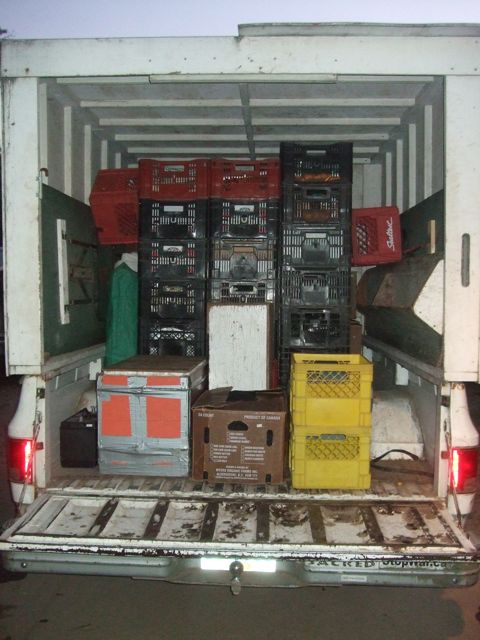
For the weekend markets, the day starts early with loading the truck -- at 5 or 6 a.m. When everything is loaded in the height of the season the market truck should look something like this:

While driving to the market we sometimes get a great view of the sunrise coming up over the mountains and valley.

And once we arrive at the market, it's time to transform an empty square, parking lot or park into a carnival-esque market scene. The White Rock market is held in a square between two condo towers. On this particular week someone threw old food from their window at market vendors during set-up. Maybe the set-up time is too early for some people on the weekend. We were lucky no one got hurt, though, given that the package fell about 15 stories.


At our Lonsdale Quay market on Saturday mornings we have the ever-able Storm who helps us. He's been part of the market scene for longer than we have and knows how to navigate piles of produce boxes and set up a market stand with his eyes closed.


Once everything is set up we occasionally get an opportunity to admire the presentation before starting to sell. If we finish setting up too early before the start of market, our customers begin to get a bit anxious for having to wait.


A major part of market set-up is presentation. Making the food look beautiful in large piles and orderly rows goes a long way to helping sell everything.


We try to be strict about only selling after the advertised opening time. At Lonsdale Quay there is no strict start time, although the market is advertised as starting at 10 a.m. Until two years ago, we started selling as soon as we were st up. But our customers started arriving earlier and earlier.

One week I pulled the truck in to begin setting up at 7:30 a.m. and there were two customers waiting who proceeded to take boxes off the truck and began rummaging through for produce. We were sold out before the market opened, much to the dismay of customers who arrived on time. That's bad market management.

The next week I arrived with a rope and a handful of coffee cards. I tied off the stand and told customers we would no longer sell before the advertised start time. I handed out coffee cards so people could get a complimentary coffee on the corner and wait. People complained fiercely, other vendors continued to sell early and the market society didn't care.

We still sell out and customers appreciate knowing when the market actually starts in order to plan their days. We've maintained strict start times since. Remember, the early bird only gets the worm. Everyone else gets some organic produce with their worm.

Every so often before the market starts a market manager comes by to talk to us. On this particular week in White Rock, Market Manager Helen came by to tell us that we should have a tent over our stall. I had forgotten the tent that morning. The health department gets upset when we don't have a tent because they're afraid birds will poop on our produce and cause mass pathogenic outbreaks. It's amazing what they can dream up in their offices.

It was a great day for working without a tent (no rain). Jeremy forgot the cash float the following week. In the past I've forgotten the tent, the scale and the float (not all on the same week). Any one of those instances could lead to a terrible day. But we managed to recover each time thanks to the generosity and ingenuity of other vendors and market volunteers.


Then we can finally get to work selling food. The weather has a major impact on how busy it will be (I understand that people don't eat on rainy days). Lonsdale Quay is the one exception to this rule. The north shore is always wetter than anywhere else in the Lower Mainland and its residents know that they have to brave the rain or spend much of their lives indoors.


If all goes according to plans, our stall is more-or-less empty within a few hours. By the way, we don't sell off produce at the end of the day for lower prices. We take it home and eat it.

When people try to get food for less than the marked price we respond in one of two ways. On a good day we simply explain that we won't undermine the price other customers have paid and that the posted price reflects the value of the food based on what it costs us to bring it to market. On a bad day we ask people to buzz off.

Our philosophy for farmers markets is to sell out rather than throw out. We could take a lot of produce to keep the stall fully stocked until the end of the day (and probably achieve some additional sales), but much more food would be wasted. Rather, we order up or down on a weekly basis depending on previous weeks' sales and the weather forecast.

Supermarkets have fully-stocked produce sections and it means that a high percentage of their produce gets thrown out. In fact, most supermarkets don't make money on produce. The real profit is made from packaged food that can sit on shelves for months and doesn't have to be thrown out. They sell produce cheap as a loss leader to get people into the store.


And before returning home to unload the market truck we stop off at the local Co-Op gas station to fill up for the next market trip. It's a good reminder that despite our attempts to sell local, we're still dependent on oil for the moment. There's still work to do.

Wednesday, August 25, 2010

Great book on human-scale farming

We are excited about the release of a new book about small-scale, local farming. Up We Grow! is written by Vancouver author Deborah Hodge for children ages 4-7. The book features photography by Brian Harris, showing small farms and farmers from around British Columbia.

The book is excellent for its portrayal of the human side of food production. Too often discussions of local food focuses on pictures of food. Up We Grow! shows the people who grow food in our communities. This is a feature of Brian Harris' photography; he captures the community and cultural elements of farming. Deborah's text engages children with questions about how they celebrate the seasons and inquiries about their favorite foods.

What we especially like about this book is that it features our farm. The text is based on visits the author did over a one-year period, documenting the activities of the farm. The farm in the book is a composite of many farms, using Brian's spectacular photography.

The book is available at bookstores around British Columbia and beyond. Kidbooks in Vancouver is hosting a book launch on Thursday, 26 August from 7-9 p.m. Check out their amazing window display here.

We have copies of the book for sale at our farmers market stands at Lonsdale Quay (Saturdays 10-3), White Rock (Sundays 9-1), Langley (Wednesdays 3-7) and New Westminster (Thursdays 3-7).

Thursday, July 22, 2010

Farm activities this month

It's already into the final stretch of July and I haven't done much to update the blog lately. Here's a summary of what's happening at this time of the year.

The fields are a constant challenge to stay on top of -- from weeds and irrigating to constant harvesting, we're experiencing busy days. Luckily the rain has held off and that has made weed management a bit better. Each week there's something new to harvest as well as another item that has gone out of season.

Our farmers market stalls are getting quite full and should be packed in another couple of weeks as we get into beans, sweet onions and tomatoes. The berries continue at full pace and we're getting the first few blueberries off of our new planting of bushes.

The freezer is beginning to fill up with frozen rhubarb and berries. Our rhubarb crop hadn't done well in the spring, but has rebounded. The harvest now will be for Aphrodite's Cafe and Pie Shop in Vancouver.

This weekend we will begin transplanting our winter crops -- cauliflower, broccoli, kale, collards and brussels sprouts. Our final seedings of carrots, parsnips, beets and beans are done. We've turned a corner where at least seeding is largely out of the way.

We're had a couple of challenging crops. We haven't had much luck with corn this year -- the sweet corn has had terrible germination and the crows got a lot of what did come up. It was hardly worth trying to weed in the end, and the beds will likely be used for winter crops. The milling corn will hopefully produce better results.

The impact of the Spotted Wing Drosophilia Fruit Fly still remains to be seen. We're finding them in the fields, but haven't had obvious damage to the fruit to make it unmarketable . . . yet. But we're warning customers about the challenges and offering full refunds on any product that people don't like.

After having to put down a goat earlier in the month due to a lymphatic infection we're now preparing to have all the other goats tested for chronic problems that can make them more susceptible to infections. In the meantime, we're milking two does and getting about 1 gallon of milk each day -- enough for drinking and making regular batches of cheese.

In the fields everything is incredible to watch. As the days shorten, the onions and shallots respond by beginning to develop their bulbs. Our flower patches are humming with activity, attracting millions of beneficial insects that are cleaning up aphids on other crops. Garter Snakes are cleaning up slugs and small rodents in the fields. The farm's new hives of honey bees are busy gathering nectar and pollen -- we should have an excellent blackberry harvest with all the pollination taking place.

In personal news, Jeremy has been accepted by Slow Food Vancouver as a delegate to this fall's Terra Madre celebration in Italy. If you're interested in helping sponsor this hard-working farmer's airfare, he would surely be grateful.

And while Jeremy is in Italy we'll be finishing the final markets and preparing for the growth of our family -- a new baby due on or about 11 November. Winter will, no doubt, be as busy or busier than summer, only in different ways.

Here's hoping your summer is going well -- bountiful gardens, great vacations if you do that kind of thing in the summer, and a great dose of sunshine.

Monday, July 12, 2010

Tailgate Party at the Market

At the last White Rock Farmers Market I worked, Paige, Clara and Roxie showed up part way through for a visit. With Focaccia Bread from Fieldstone Bakery and a bag of Kettle Corn, a tailgate party broke out on the market truck.