Life and thoughts from a small-scale organic farm . . . and its farmers

This is a blog that explores ideas around the growing of food and community at Glen Valley Organic Farm.
Showing posts with label goats. Show all posts

Friday, May 13, 2011

More goats

Over the course of 48 hours last week, the size of our goat herd expanded from five to 12. First, Worri had triplets and the next day Jumper had four kids. Needless to say, they are always a hit and an incredible spectacle.

Our new term for the pile of goats (this tends to be how they sleep) is a Goat Cuddle Puddle.

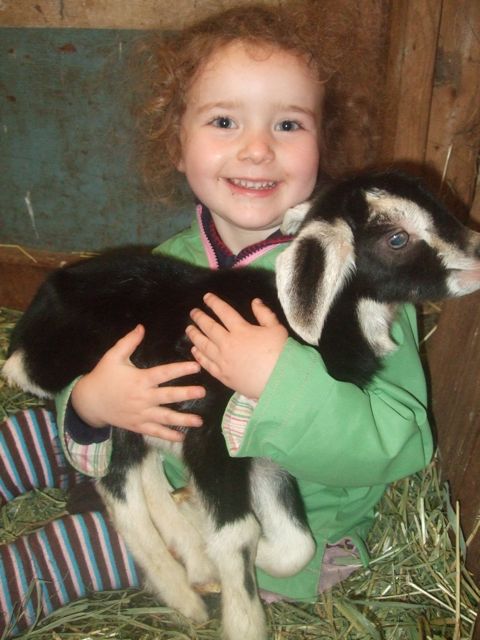
How long can a three-year-old cuddle a goat? We've always had to intervene before finding out.

This is Jumper cleaning her new kids after being born. When we took this photo we expected that she was finished, only to watch as one more kid came out moments later. The dark liquid in the bucket in the corner is molasses in warm water -- a post birth treat for the new mother.

There are two more goats that will have new kids in the next couple of weeks. They make for a busy spring!

Thursday, May 5, 2011

Baby goats -- Exciting day on the farm

The birth of new goats is always exciting on the farm. Our first set of kids arrived yesterday while we were all eating lunch. The farm children got to skip their nap to witness the exciting event.

Just minutes after the birth, all three kids are standing up, looking to feed. Worri, their mother, is trying to clean them all. Notice that the two females have exactly them same colouring as their mother while the male is all white, just like his Saanen father.

We relish the cuteness of baby goats. It's only a matter of time before they're just like the rest of the goats . . . lots of personality and, depending on the goat, stubborn and obnoxious.

Mama Worri stands guard as her kids snuggle in a pile under the manger. these kids arrived a full 10 days earlier than the average gestation for goats. Yes, we were surprised . . . and not quite prepared for this yet!

It's always a relief when the kids start looking for food and when the mother lets them feed. They're pretty self-sufficient animals as far as birthing goes. These two kids are competing for the same teat.

Four more goats are bred and will be kidding over the next month.

Wednesday, September 15, 2010

Breeding Time

Fall is approaching and that means figuring out certain logistics . . . like how we will get our goats bred. We don't have a buck on the farm, so that means we'll have to take our dairy goats out on the town (or to another farm that is) to be bred.

I'm trying to figure out how the online dating ad would look for this: "Single female goat seeking non-committal male goat for 20 minutes. Must be from good milking stock."

The photo, by the way, was taken by Brian Harris last September. It shows two of Alyson's goats during mating season. For farmers without televisions, this is an exciting time of year.

Monday, July 12, 2010

Making Valençay Cheese

One of the best parts about having goats has been experimenting with making different cheeses. Recently I set out to make some Valençay cheese -- a soft, mold-ripened goat's milk cheese. Given the time it takes to make and the success of the process, I couldn't help but post some images.

First, the cheeses after draining from the whey. They get sprinkled with ash, which acts as a preservative and helps the skin to dry (along with a sprinkling of salt).

Following a couple of weeks of aging, a white mold (the same type of surface mold you find in camembert or brie) has grown over the ash and the cheese is ready to eat.

We enjoyed our first pyramid with friends amidst a crazy meal with toddlers. The cheese provided at least a moment of focus in an otherwise hectic meal.

Monday, April 5, 2010

Waiting for the sun


I've neglected doing a posting for a while amidst various other tasks and taking some down time before the start of the season. Here's a summary of what's happening on the farm these days as we get into the spring season.

Most of the potatoes went into the ground a couple of weeks ago. There's one bed's worth of spuds still waiting . . . the weather changed faster than they could be dealt with. Kale and Collards also went in.

In fact, I was away for the planting. A good friend was getting married in Ottawa (he must have wanted farmer friends present, because March is a great time to attend weddings in terms of workload and schedule adjustments, not to mention airfares and hotel costs). That means Jeremy was hard at work doing much of the work solo. Word is that we was in the field one evening, working on the tractor in the dark with spotlights on trying to beat the rain.

Since then we've been waiting on the weather to dry up and warm up again. The early start we had in February has evaporated and we're back to a slow start similar to the past couple of springs.

Nonetheless, the warm February has brought about an early crop of flowers. The daffodils are almost finished and tulips are in full bloom. We purchased hundreds of bulbs this past fall when they were on discount (end of season) from a bulb company. As a result, we have a whole new array of spring colour on the farm. This adds to the multitude of daffodils already present, planted by farm shareholders in past years. The results are visible in the photo at the top of this post.

Our 2010 CSA is now full with a small waiting list. We'll consider whether or not we can accommodate the waiting list later today.

We had the chickens slaughtered on Thursday, which means we have a freezer full of stewing hens and a break from the daily chores related to feeding, collecting eggs, packing and such. I'll have another blog post finished soon about slaughter day (I'm sure you can hardly wait). Thanks to BC's meat regulations we can't sell these birds because they were slaughtered on-farm.

The other major event has, of course, been the arrival of the new baby goats. Six kids (four male, 2 female) were born to four does in mid- to late-March. It's a manageable number. It'll give us the ability to increase of milking herd in the next year or two with the two females and provide us with a good supply of farm meat next winter from the boys.

New goats bring about a whole set of tasks ranging from monitoring feeding from the mothers to removing horns and castrating. As of this weekend we're also milking three of the adult goats -- a daily event at 6 a.m.

Milking got off to a shaky start. We put the kids in a separate pen overnight. The first night is noisy across the farm. Babies cry much of the night and does make their displeasure known. By morning the maternal instincts lead some of the goats to fight us for the milk.

Last night, however, the kids seemed settled into the new routine (they pile together under the manger) while the mothers realize that they get a full 10 to 12 hours without babies -- not bad for a break. They aren't as uncomfortable with us milking in the morning either. The kids still feed all day, so everyone is happy.

I recalled the other day that at their last farm the goats listened to the CBC during milking. Having constant voices seems to sooth them, but I wonder if they will produce differently based on the host. I imagine they would prefer Radio 2 over Radio 1, especially at 6 a.m. We'll have to give this a try!

The one last activity of the season is to do taxes. Agricultural taxes are a bit more involved than I did in my past, but I still refuse to pay someone to do my taxes. I'm really trying to get this done in the next few days of heavy rain. Once the weather turns it'll be too busy outside to worry about catching up on paperwork.

Monday, March 15, 2010

Two More Goats

Roxie takes a moment to welcome Rosencrantz into the world.


Jumper gave birth to Rosencrantz and Guildentstern, both boys, on Saturday afternoon. Our friends (and CSA members) Jill and Dale were out for a visit and got to help with the birth and aftermath.

The names reference the fated characters in Hamlet, and pay homage to Tom Stoppard's play Rosencrantz and Guildenstern are Dead. It helps remind us of the future destiny of these guys.

The goats born on Friday are named Marshall and Rosenberg, in honour of the developer of Compassionate Communication. Whether or not it's an honour to have goats named after you depends on your own opinion of goats, I guess.

Now we're just waiting on Gertie and Zola. Gertie is looking about ready to have her kids any time. Zola will likely be another week or so. There is a huge benefit to knowing when your goats were bred. Next time we'll know!

Friday, March 12, 2010

First baby goats of the season

Two male kids were born this morning. I checked in on the goats just after 6 a.m. and realized that Worri was in labour. I moved her to a separate area and by the time breakfast was over at 7:30 the two little ones were out and licked off. They're both feeding and Worri is doing well -- she downed about three liters of water and molasses in two minutes!

New kids are a sure sign of spring and the cycle of life on the farm. By the time these two boys will be ready for slaughter in the fall we'll have gone through an entire season of farming.

So, as we balance the obligations of tending new animals with harvesting for market tomorrow I am reminded of the quote we put on our farm Thanksgiving card in 2009. From "The Pleasures of Eating" by Wendell Berry:
The pleasure of eating should be an extensive pleasure, not that of the mere gourmet. People who know the garden in which their vegetables have grown and know that the garden is healthy and remember the beauty of the growing plants, perhaps in the dewy first light of morning when gardens are at their best. Such a memory involves itself with the food and is one of the pleasures of eating. The knowledge of the good health of the garden relieves and frees and comforts the eater. The same goes for eating meat. The thought of the good pasture and of the calf contentedly grazing flavors the steak. Some, I know, will think of it as bloodthirsty or worse to eat a fellow creature you have known all its life. On the contrary, I think it means that you eat with understanding and with gratitude. A significant part of the pleasure of eating is in one's accurate consciousness of the lives and the world from which food comes. The pleasure of eating, then, may be the best available standard of our health. And this pleasure, I think, is pretty fully available to the urban consumer who will make the necessary effort.
This helps keep the season in perspective.