Life and thoughts from a small-scale organic farm . . . and its farmers

This is a blog that explores ideas around the growing of food and community at Glen Valley Organic Farm.

Tuesday, March 22, 2011

Growing for Gardeners: Spring Transplants

Here we go with a new idea: We're growing certified organic veggie transplants for home gardeners.

This year we wanted to do something more than just growing veggies for our farmers markets. We're also growing to help our fellow gardeners with their own plots of land.

Every year we grow tens-of-thousands of transplants for our crops. And every year more and more of our regular customers tell us that they're trying out their own community garden plots, balcony gardens or their own backyard. And we always get requests for transplants.

This year we're growing an array of veggie starts for home gardeners to use in their own gardens. We're seeding harder-to-grow crops like broccoli and cauliflower, onions, various greens, herbs and many more.

We're also ready to take custom orders to match your own garden plan.

Our transplants will be available at our Farmers Market stands beginning in May and direct from the farm by special arrangement. We'll also be at some special events, such as the Stone Soup Festival in East Vancouver on May 7.

To discuss your garden plans or to place a special order, please e-mail us at glenvalleychris@gmail.com.

Thursday, March 10, 2011

Watch Me Grow! Growing food in the city

Being a new parent I am witnessing the incredible experience of raising children with an understanding of where their food comes from. Turns out that many people are looking for a similar experience for their children -- and there's a lot of help to do this.

A new book, Watch Me Grow: A Down-to-Earth Look at Growing Food in the City, is a resource to help introduce children to urban agriculture. Written by Vancouver children's writer Deborah Hodge, the book is engaging. It introduces children to food in the city, asking questions about how the readers experience the growing of food, and suggests activities to help develop a closer relationship to food and growing.

Exploring everything from where food can be grown in the city to how the food can be shared, the book is an inspiring tour of the ways city dwellers can get a bit closer to the sources of their food.

Illustrated with photos by Brian Harris, the book is visually stunning. Brian captures the colour, diversity and beauty of food communities. Anyone who attended the Museum of Vancouver's Home Grown exhibit or who has purchased a FarmFolkCityFolk calender in recent years knows Brian's work.

In his work, Brian attempts to capture the essence of human relationships to each other and the natural world. He is not interested in fetishizing food, but rather celebrates the richness of community built around growing and nurturing our selves and our environment.

This new release is a companion to last year's Up We Grow: A Year in the Life of a Small, Local Farm.

Just in time for this blog post, today it was announced that Up We Grow! is a finalist for the Christie Harris Award (children's illustrated book category) in the BC Book Prizes. Also, The American Library Association has just listed Up We Grow! as one of the Top 10 Books on the Environment for Youth.

Of course, some of my excitement about these books comes from the fact that our farm is featured in some of the photographs and the text of Up We Grow! was largely researched at our farm. We're thrilled to be part of such an exciting, educational celebration of local food.

I have copies of both books available for sale. Just let me know and I can get them to you.

Friday, February 18, 2011

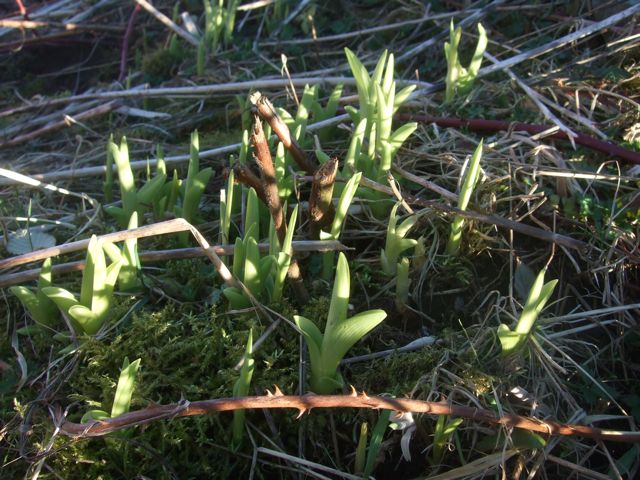
Hints of spring on the farm

The day lilies on the farm are up . . . within a week or so I think we'll be eating the shoots!

The lean-to cold frame is getting full with transplants. These are all onions and shallots on a heated table. The transplants come out here, where they get natural light, after the seeds have germinated and emerged.

This is what the floor of our indoor start room looks like at the moment. Kale, green onions, tomatoes, artichokes, celery, onions and leeks are germinating at the moment.

This note on a seed shipment from Johnny's Seeds (a US company) has me wondering. Is this a warning to the purchaser of what they can (and cannot do) or is it a note for customs to tell them that it's seed for growing, not resale? I'm going to call next week to find out.

Tuesday, February 15, 2011

Videos: Primers on joining a CSA

Here are two great videos about Community Supported Agriculture programs. In case you're thinking about joining ours, we think these represent our philosophy and the nature of our CSA.


Thursday, December 9, 2010

2011 CSA Subscriptions Now Available

Glen Valley Organic Farm runs a small Community Supported Agriculture program in partnership with the NOWBC Co-op. Members of the CSA become partners with the farmers -- they purchase a share of the crop at the start of the season and receive a weekly Harvest Box over 16 weeks in the summer. Our first season of running our CSA was in 2009. The 2011 season marks a change for us as we increase the size of the CSA program and decrease the number of markets where we sell.

We are now selling subscriptions for our 2011 season. Read on to learn more.

Philosophy

We grow 45 different certified organic crops at Glen Valley Organic Farm. By growing a diversity of crops we are able to offer a wide selection to our customers through a Community Shared Agriculture program and at Farmers Markets. This diversity also protects us against weather and pests that inevitably wreak havoc on individual crops one year to the next. Direct sales to the public provide us with an income that allows us to use sustainable practices while also paying fair wages to our employees.

We think a Community Shared Agriculture program is an excellent way for consumers and farmers to connect and work with each other. By paying for a share of the crop at the beginning of the season, members help their farmers to cover start-up costs that often require lines of credit. In return, we provide subscribers with the first pick of our finest produce at incredible value, along with regular farm updates and opportunities to visit the farm -- both to work and for fun.

We recognize that a CSA program doesn't meet everyone’s needs. As a result, we invite you to read through the information below to determine whether or not our CSA is a good fit with your eating habits.

Cost

The Glen Valley Organic Farm CSA costs $520 in 2011. Half-shares are available for $320 (a half-share costs more than half of a regular share to cover packing and delivery costs, which are the same regardless of the share size). A $100 deposit is required immediately to hold your spot for new subscriptions. 2010 subscribers have until 1 February to pay their deposit. The remainder for all shares is due by 1 April.

Duration

The CSA starts mid- to late-June, depending on when crops begin to mature. It will run for approximately 16 weeks, although we may provide slightly smaller boxes at the start of the season and extend the program by one week, depending on selection and quantity available.

Delivery

In Vancouver our CSA boxes are delivered to pick-up depots by the NOWBC Co-op. Please check their depot page to see if there is a drop-off near you. Deliveries are made on Wednesdays or Thursdays, depending on the depot.

We will also deliver boxes to our stand at the Langley Farmers Market (Wednesdays) and the New Westminster Farmers Market (Thursdays). If there are enough subscribers, we will also consider drop-off locations in other south of the Fraser locations (Surrey, Walnut Grove, Fort Langley, Abbotsford and/or Mission). Let us know if you live in one of these areas and would be interested in hosting a drop-off location.

Box Contents

Each week's box contains a variety of in-season fruit and vegetables from our farm. We grow 45 different fruit and vegetable crops. A box is sufficient to provide vegetables for a family of four for a week. Some members who are vegetarian or follow raw food diets use all of the contents themselves. Other members share their boxes with another couple or family. Many members also preserve some of their box contents for winter eating. To determine whether this CSA is sufficient for your needs, consider whether you normally spend $32/week on fresh vegetables. If not, you might want to consider finding someone to share your box with.

A late-August 2010 box looked like this:

1 bunch Rainbow Chard
1 bunch Dandelion
1 Romaine Lettuce
1 bunch Dill
1 lb Green Beans
1 bunch Beets
2 Mini-Cabbages
3 lbs Carrots
1 Long English Cucumber
2 Slicer Cucumbers
2 Garlic Bulbs
1.1 lbs Leeks
2 Sweet Onions (one red, one white)
2 Beefsteak Tomatoes
1 bunch Green Onions

Substitutions and Cancellations

We are unable to accommodate substitutions. In order to help you learn how to use vegetables that might be new to you, we will include regular recipes on our farm blog at http://glenvalleyorganicfarm.blogspot.com. We are also unable to cancel boxes. As a CSA subscriber, you are purchasing a share of the season's harvest, regardless of holidays or other obligations. If you are going on vacation we invite you to offer your box to a friend or neighbour. We also offer an option through NOWBC Co-op to donate your box to a food bank if you are unable to use it on a given week.

Connection with the farm

There are a number of benefits to being a member of our CSA. This includes:

Work parties
This might not have been on everyone's list, but some people requested a CSA in a truer model of shared agriculture -- including the work. As a result, we will try to organize a few weekend work parties throughout the season when you can come out and work with us on specific projects. In exchange, you can choose additional produce to take home or even create your own box for that week. Plus, it's a chance to see the farm at different stages of the season and an opportunity for us to get to know our members better.

Fun parties
Our CSA members are invited to our open house in May or June and we're also going to plan a big harvest shin-dig for late September or early October. This will include a large potluck and a preserves exchange. Last year's CSA parties were a blast.

Farm updates
Our weekly blog posting will provide you with an insight into farm operations, thoughts about agriculture and a number of recipes to help you learn about new ways of using the vegetables in your box.

How to subscribe

To subscribe to our Harvest Box CSA, mail your deposit cheque for $100 along with your contact information (address, phone number and e-mail) to the address below. We will notify you when we receive your deposit. The remaining amount of our subscription fee will be due by 1 April. Alternatively, if you live in Vancouver you can enroll and pay online through NOWBC. E-mail glenvalleychris (at) gmail (dot) com for more info on this option.

Glen Valley Organic Farm

8550 Bradner Road, Abbotsford BC V4X 2H5

Small-Farm Business Planning Resources

If you've been following my Twitter account or reading up on the local small-scale agriculture news, you may have noted that I've been teaching the Business Planning component of Kwantlen University's Richmond Farm School this fall. For anyone working on starting a new small farm, here is a summary of some of the business planning resources I would recommend.

***Updated 9 December 2011***

Business Planning

  • Business Planning for Small-Scale Community Farming Enterprises. Published by FarmFolkCityFolk and The Land Conservancy. This is an accessible, step-by-step guide to business planning for small-scale farms. Excellent for use as a workbook, although the end business plan may need some refining, based on a more professional business planning template. http://ffcf.bc.ca/programs/farm/cf/business-plan.html
  • Guide to Starting a New Farm Enterprise. The Province of BC’s business planning guide for small- and medium-sized farms. A very good guide for understanding the components of a successful small- to medium-size farm enterprise http://www.agf.gov.bc.ca/regional/NewFarm/NewFarm.htm
  • Urban Farm Business Plan Handbook An excellent resource for researching and writing a business plan. Written for urban farms, this document has detailed worksheets to help guide users through the process of developing a useful business plan. http://www.epa.gov/brownfields/urbanag/resources.htm#handbook
  • SmartFarm: A centralized site by the Province of BC's Ministry of Agriculture and Lands, providing information about programs, events and resources for farms. http://www.smartfarmbc.ca/

Business Management
Finances and Bookkeeping
  • Farm Financial Records: A Guide to Managing for Success. Published by the Canadian Farm Business Management Council. A comprehensive guide to managing your financial records. Available through www.farmcentre.com (along with a variety of other publications that might be of use).
Whole Farm Plan
  • Whole Farm Plan Guide. Published by FarmFolkCityFolk and The Land Conservancy. When purchasing a property and/or establishing a farming project a whole farm plan helps develop an assessment of the farm’s capacity, resources and opportunities. It also helps to benchmark ecological indicators and, ultimately, develop shared vision and goals for those involved in managing the land. http://ffcf.bc.ca/programs/farm/cf/planGuide.html
Land Access Agreements
  • A Guide to Farmland Access Agreements Leases, Profits à Prendre, Licences and Memoranda of Understanding. Published by FarmFolkCityFolk and The Land Conservancy. Comprehensive guide to types of land access agreements, benefits and drawbacks of each and sample agreements. http://ffcf.bc.ca/programs/farm/cf/laa.html
Local Government
  • BC’s Farming and Food Future: A Local Government Toolkit for Sustainable Food Production. Published by FarmFolkCityFolk and The Land Conservancy. At times, the best plans for sustainable agriculture run up against local government regulations. This guide offers a toolkit for advocating change to municipal regulations around agriculture. http://ffcf.bc.ca/programs/farm/cf/toolKit.html
Magazines
  • Small Farm Canada. www.smallfarmcanada.ca The perfect resource for Canadian small-scale farmers. Covers a variety of agricultural and business-related topics for fruit, veggie, livestock and agritourism plus much more.
  • Growing For Market. www.growingformarket.com An American resource, written specifically for farmers who market primarily through farmers markets and CSAs. Great info on growing practices, marketing and tools. One of the best publications for small farmers operating a farm enterprise for profit.
Labour
  • Stewards of Irreplaceable Land. http://www.soilapprenticeships.org/ A BC-based apprenticeship program, linking farmers and apprentices from across Canada.
  • WorkSafeBC. Once you find your employees, you’ll have to enroll in WorkSafeBC so your workers are covered by the provincial workers compensation program. www.worksafebc.com
Books
Coleman, Eliot. (1995) The New Organic Grower: A Master’s Manual of Tool and Techniques for the Home and Market Gardener. Chelsea Green Publishing.
  • Not a business planning resource, per se, but an essential introduction to organic growing. Excellent demonstration of how to merge thinking about crop planning, marketing and deciding what to grow based on what sells. Crucial if only for one piece of advice: don’t try to farm without taking a day off each week!
Henderson, Elizabeth. (2007) Sharing the Harvest: A Citizen’s Guide to Community Supported Agriculture. Chelsea Green Publishing.
  • An essential resource for starting a CSA. Includes everything from crop planning through to alternative means of engaging under-serviced communities. Based on work by North America’s original CSAs.
Wiswall, Richard. (2009) The Organic Farmer’s Business Handbook: A Complete Guide to Managing Finances, Crops, and Staff—and Making a Profit. Chelsea Green Publishing.
  • A business planning handbook written specifically for organic farmers. More suited to the scale and focus of small-scale vegetable farms. Includes a disc with planning and efficiency tools.
Canada Revenue Agency
Business Risk Management

General
Profitability on a small farm, Paul and Sandy Arnold. The best summary article of how to approach the management of a small-scale farm. http://www.cog.ca/documents/Winter04Arnold.pdf

Wednesday, November 10, 2010

Changes coming for next season

There are some changes coming to how we market our produce next season. I haven't posted for a while, largely because of time constraints. But I wanted to note an important change.

Beginning in the 2011 season our farm will no longer be part of the Langley Organic Growers marketing co-operative. We decided to step out of this collective of organic farms in an effort to concentrate our sales efforts in fewer venues.

As many of our regular customers know, we have been selling at 9 farmers markets in 2010. Five of these were through Langley Organic Growers (all four Vancouver markets and Coquitlam). The remaining four markets (Lonsdale Quay, White Rock, New Westminster and Langley) are stands we do alone as Glen Valley Organic Farm.

Due to personnel changes on our farm this season, Langley Organic Growers had difficulty staffing all of the markets we were registered to attend. In the meantime, we have just completed the second year of our Community Supported Agriculture Harvest Box program. We have received a number of requests to expand our CSA program next year. As well, we regularly send less produce to some markets in an effort to supply the rest of the markets.

In the past, our marketing co-operative has felt an obligation to attend a new market in order to support its development and provide customers with an organic alternative. Due to a growing number of new, small farms, this is no longer necessary. And due to the growing number of markets, it is no longer possible, either.

We recognize an opportunity to concentrate our efforts on our four markets (possibly one more) plus our CSA in the coming season. Supplying as many markets as we have been doing is no longer sustainable for us in terms of energy and attention. In addition, we see a need to focus some attention on supplying under-served markets, including low-income customers and neighbourhoods outside of Vancouver-proper.

Langley Organic Growers has included Myers Organic Farms, Olers Farm, In Season Farm and Greg Reid Farm and Glen Valley Organic Farm since 2007. Prior to this, Friesen Farm and Glorious Organics were part of Langley Organic Growers while In Season and Greg Reid Farms were not.

Before the 2007 season Friesen Farm and Glorious Organics formed Organic Farm Connection and Langley Organic Growers welcomed In season and Greg Reid Farms. This arrangement benefited all farms by allowing for less congestion at market stalls and greater capacity to supply more customers.

The farms involved in Langley Organic Growers and Organic Farm Connection include some of the original organic farmers in the Lower Mainland. It has been a privilege to work so closely with these experienced farmers during our entry into farming.

This past year has been exciting. More new farmers are coming to markets and this is providing many shoppers with more choice. No one farm or farm co-operative needs to feel an obligation to supply all of the markets.

We know that our departure from Langley Organic Growers will provide the remaining farms with more opportunity to grow crops we have previously supplied. It will also streamline the group's overall operations.

One of the most important lessons we have learned since starting farming is that co-operation is the cornerstone to successful agricultural operations. No one farm or farmer can do everything. The farm community supports each other in times of crisis as well as in regular daily operations. Likewise, the partnerships we have with urban food groups is very strong and provides us with the ability to farm in a small-scale, sustainable fashion.

Our dream for the sector is a future of thousands of small-scale farms practicing sustainable, intensive growing practices and marketing direct-to-consumer and/or co-operatively through a variety of channels. The local food scene is changing rapidly and this dream seems attainable with some hard work and a focus on end goals.

So, with all of this in mind, we don't think of our departure from Langley Organic Growers as an attempt to "go it alone". Rather, we're refocusing and figuring out some next steps in an effort to continue to grow and change in tune with the larger local, organic food movement. We're happy to have so many wonderful people to work with.