Life and thoughts from a small-scale organic farm . . . and its farmers

This is a blog that explores ideas around the growing of food and community at Glen Valley Organic Farm.
Showing posts with label spring. Show all posts

Saturday, May 21, 2011

Images of the past week on the farm

The season got a kick-start this wee with some wonderful, warm weather. We were able to catch up on weeding, seeding and transplanting. Here are some of the things we noticed on the farm this week.

Above, the strawberries are in full flower. We anticipate tasting the first berries of the season next month.

Our neighbour, the Fraser River, has been rising over the past couple of weeks. A heavy snow pack in parts of the province means we anticipate a high river level this year, although we are unlikely to face any flood threats. Nonetheless, when the river is high, the ditches are unable to drain and we may see back-ups into our fields during heavy rainfall.

It's always a relief to see certain crops emerging from the earth. This tiny row of parsnips came up this past week, three weeks after seeding. This crop is grown from Harris Model variety seeds we saved on the farm two season ago.

Our new mason bee condos are seeing activity. A couple of holes are already filled by bees with their eggs, pollen and a mud plug.

Tricia's bees are doing very well. As soon as the day warms up, they're out collecting nectar on the farm.
If you've even used the term "it's a tough row to hoe", hopefully you've had the chance to hoe a tough roe. The above bed was planted in potatoes by mistake. The bed is lumpy and weedy, and a miscommunication saw it getting planted in too early. Our apprentices did a great job cleaning it up this week.

Viewing the farm early in the morning provides a stunning perspective of the beds again the valley slope and sometimes the mountains in the distance. This view reminds me why I enjoy farming (being outside in this beautiful space) and how much work we have to do to keep on top of the weeds!

This is a similar view, from the tractor, getting beds ready for seeding and transplanting.

These are some of our earlier plantings of lettuce and kale. They grew a lot this week. Lettuce generally doubles in size each week, so we might have some head lettuce for market in a few more weeks.

It's always satisfying to see the potatoes sending up their first leaves.

Our rhubarb is always the first big crop for the season. This week we sent rhubarb to an organic distributor in Vancouver, our restaurant distributor, Aphrodite's Pie Shop and, of course, the farmers market.

We seeded many beds this week, including spinach, dill, cilantro, beans, beets, sunflowers and wildflowers. Kate, above, is using the Earthway seeder on a future crop of spinach.

The goats are all doing well. The seven kids are growing fast and two more does will kid in the weeks ahead.

This coming week sees the start of the Langley Farmers Market, the White Rock Farmers Market, transplanting many new crops (strawberries, squash and fennel) and lots of weeding.

Friday, May 13, 2011

More goats

Over the course of 48 hours last week, the size of our goat herd expanded from five to 12. First, Worri had triplets and the next day Jumper had four kids. Needless to say, they are always a hit and an incredible spectacle.

Our new term for the pile of goats (this tends to be how they sleep) is a Goat Cuddle Puddle.

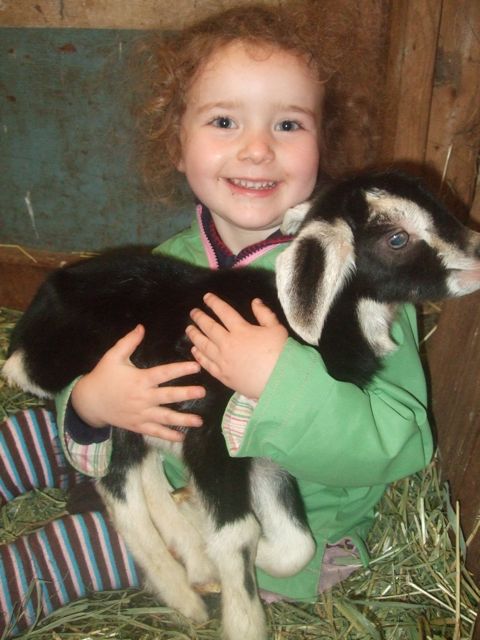
How long can a three-year-old cuddle a goat? We've always had to intervene before finding out.

This is Jumper cleaning her new kids after being born. When we took this photo we expected that she was finished, only to watch as one more kid came out moments later. The dark liquid in the bucket in the corner is molasses in warm water -- a post birth treat for the new mother.

There are two more goats that will have new kids in the next couple of weeks. They make for a busy spring!

Thursday, May 5, 2011

Baby goats -- Exciting day on the farm

The birth of new goats is always exciting on the farm. Our first set of kids arrived yesterday while we were all eating lunch. The farm children got to skip their nap to witness the exciting event.

Just minutes after the birth, all three kids are standing up, looking to feed. Worri, their mother, is trying to clean them all. Notice that the two females have exactly them same colouring as their mother while the male is all white, just like his Saanen father.

We relish the cuteness of baby goats. It's only a matter of time before they're just like the rest of the goats . . . lots of personality and, depending on the goat, stubborn and obnoxious.

Mama Worri stands guard as her kids snuggle in a pile under the manger. these kids arrived a full 10 days earlier than the average gestation for goats. Yes, we were surprised . . . and not quite prepared for this yet!

It's always a relief when the kids start looking for food and when the mother lets them feed. They're pretty self-sufficient animals as far as birthing goes. These two kids are competing for the same teat.

Four more goats are bred and will be kidding over the next month.

Monday, April 25, 2011

Killdeer in our fields

We are fortunate to have a wide variety of wildlife on the farm. Each spring, our farm becomes home to killdeer birds. With their tiny nests nestled into the debris and weeds of the untilled fields, it is a challenge to see their eggs. Luckily, the killdeer adults put on quite a show to get our attention.

When walking near a nest, the adult killdeer make a loud call and pretend to be injured, hoping to attract potential predators away from a nest to an easier (and potentially more fulfilling) meal. While this works in some circumstances, it also announces to the crows that there is, indeed, a nest nearby.

Killdeer make our work challenging at times. They nest in the middle of the fields, often necessitating a tractor detour in order to avoid their nests during field preparation. At the same time, they eat a lot of pests and are phenomenally entertaining to watch. Unfortunately, as with the nest above, even if we are able to find a nest and work around it, other animals such as crows and ravens take the eggs.

Overall, killdeer are one piece of a larger part of the biodiversity we try to foster on the farm. Their presence provides us a benefit and, in turn, we try to ensure our farm is friendly to the wildlife looking for space in an increasingly crowded landscape.

For more information about the killdeer, check out the Hinterland Who's Who profile.

Tuesday, March 22, 2011

Growing for Gardeners: Spring Transplants

Here we go with a new idea: We're growing certified organic veggie transplants for home gardeners.

This year we wanted to do something more than just growing veggies for our farmers markets. We're also growing to help our fellow gardeners with their own plots of land.

Every year we grow tens-of-thousands of transplants for our crops. And every year more and more of our regular customers tell us that they're trying out their own community garden plots, balcony gardens or their own backyard. And we always get requests for transplants.

This year we're growing an array of veggie starts for home gardeners to use in their own gardens. We're seeding harder-to-grow crops like broccoli and cauliflower, onions, various greens, herbs and many more.

We're also ready to take custom orders to match your own garden plan.

Our transplants will be available at our Farmers Market stands beginning in May and direct from the farm by special arrangement. We'll also be at some special events, such as the Stone Soup Festival in East Vancouver on May 7.

To discuss your garden plans or to place a special order, please e-mail us at glenvalleychris@gmail.com.

Friday, February 18, 2011

Hints of spring on the farm

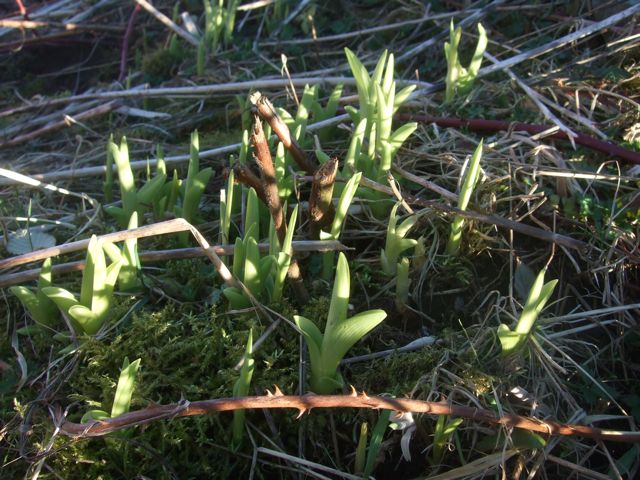
The day lilies on the farm are up . . . within a week or so I think we'll be eating the shoots!

The lean-to cold frame is getting full with transplants. These are all onions and shallots on a heated table. The transplants come out here, where they get natural light, after the seeds have germinated and emerged.

This is what the floor of our indoor start room looks like at the moment. Kale, green onions, tomatoes, artichokes, celery, onions and leeks are germinating at the moment.

This note on a seed shipment from Johnny's Seeds (a US company) has me wondering. Is this a warning to the purchaser of what they can (and cannot do) or is it a note for customs to tell them that it's seed for growing, not resale? I'm going to call next week to find out.

Tuesday, May 11, 2010

Things are growing everywhere


Not only are the fields filling up, but our tractor has started a garden of its own. None of the owners manuals discuss growing on your tractor, but our has accumulated enough soil that some hardy weeds now call it home.

Luckily more than just our tractor is growing.

It's now light out at 5 a.m. and the sun is up over the mountains by 6 a.m. when we start milking the goats. What a difference from a month ago when we were doing chores in the dark.

Indeed, we're now on the brighter side of season. May 1 marked the half-way point between Spring Equinox and Summer Solstice. The days are getting longer quickly and the plants are responding accordingly.

All of the onions, shallots and greens are established and growing quickly now. The rhubarb is being harvested, but has actually had a slow start to the season. March and April have been cool, so things slowed down after the early February start.

As of the beginning of May we also have all three of our 2010 apprentices working full time. They might contribute the occasional blog post about their experiences over the next few months -- time and weather permitting.

All of our CSA subscribers are now signed up and we're awaiting sufficient produce to start sending out their weekly boxes. Farmers Markets are getting under way this month -- three have already begun and almost all of them will be underway by the end of the month.

Our first deliveries of salad greens and rhubarb are now going into Aphrodite's Organic Cafe and Pie Shop in Vancouver.

Weeding is, remarkably, under control thus far and seeding is on track. Jeremy is installing the irrigation pump today and there is province-wide talk of drought this year. The low snowpack and dry winter means both surface water and groundwater sources will be stressed this summer. The long range forecast is for warmer and drier weather than normal.

Our "things-to-do" lists are growing steadily. This is an exciting time of the season when we all still have a lot of energy and work is still manageable. It seems hard to believe that there will be a time when we won't feel on top of things!

So, the season is getting busier by the moment and we'll anxiously await the coming weeks.

Monday, April 5, 2010

Waiting for the sun


I've neglected doing a posting for a while amidst various other tasks and taking some down time before the start of the season. Here's a summary of what's happening on the farm these days as we get into the spring season.

Most of the potatoes went into the ground a couple of weeks ago. There's one bed's worth of spuds still waiting . . . the weather changed faster than they could be dealt with. Kale and Collards also went in.

In fact, I was away for the planting. A good friend was getting married in Ottawa (he must have wanted farmer friends present, because March is a great time to attend weddings in terms of workload and schedule adjustments, not to mention airfares and hotel costs). That means Jeremy was hard at work doing much of the work solo. Word is that we was in the field one evening, working on the tractor in the dark with spotlights on trying to beat the rain.

Since then we've been waiting on the weather to dry up and warm up again. The early start we had in February has evaporated and we're back to a slow start similar to the past couple of springs.

Nonetheless, the warm February has brought about an early crop of flowers. The daffodils are almost finished and tulips are in full bloom. We purchased hundreds of bulbs this past fall when they were on discount (end of season) from a bulb company. As a result, we have a whole new array of spring colour on the farm. This adds to the multitude of daffodils already present, planted by farm shareholders in past years. The results are visible in the photo at the top of this post.

Our 2010 CSA is now full with a small waiting list. We'll consider whether or not we can accommodate the waiting list later today.

We had the chickens slaughtered on Thursday, which means we have a freezer full of stewing hens and a break from the daily chores related to feeding, collecting eggs, packing and such. I'll have another blog post finished soon about slaughter day (I'm sure you can hardly wait). Thanks to BC's meat regulations we can't sell these birds because they were slaughtered on-farm.

The other major event has, of course, been the arrival of the new baby goats. Six kids (four male, 2 female) were born to four does in mid- to late-March. It's a manageable number. It'll give us the ability to increase of milking herd in the next year or two with the two females and provide us with a good supply of farm meat next winter from the boys.

New goats bring about a whole set of tasks ranging from monitoring feeding from the mothers to removing horns and castrating. As of this weekend we're also milking three of the adult goats -- a daily event at 6 a.m.

Milking got off to a shaky start. We put the kids in a separate pen overnight. The first night is noisy across the farm. Babies cry much of the night and does make their displeasure known. By morning the maternal instincts lead some of the goats to fight us for the milk.

Last night, however, the kids seemed settled into the new routine (they pile together under the manger) while the mothers realize that they get a full 10 to 12 hours without babies -- not bad for a break. They aren't as uncomfortable with us milking in the morning either. The kids still feed all day, so everyone is happy.

I recalled the other day that at their last farm the goats listened to the CBC during milking. Having constant voices seems to sooth them, but I wonder if they will produce differently based on the host. I imagine they would prefer Radio 2 over Radio 1, especially at 6 a.m. We'll have to give this a try!

The one last activity of the season is to do taxes. Agricultural taxes are a bit more involved than I did in my past, but I still refuse to pay someone to do my taxes. I'm really trying to get this done in the next few days of heavy rain. Once the weather turns it'll be too busy outside to worry about catching up on paperwork.

Monday, March 15, 2010

Two More Goats

Roxie takes a moment to welcome Rosencrantz into the world.


Jumper gave birth to Rosencrantz and Guildentstern, both boys, on Saturday afternoon. Our friends (and CSA members) Jill and Dale were out for a visit and got to help with the birth and aftermath.

The names reference the fated characters in Hamlet, and pay homage to Tom Stoppard's play Rosencrantz and Guildenstern are Dead. It helps remind us of the future destiny of these guys.

The goats born on Friday are named Marshall and Rosenberg, in honour of the developer of Compassionate Communication. Whether or not it's an honour to have goats named after you depends on your own opinion of goats, I guess.

Now we're just waiting on Gertie and Zola. Gertie is looking about ready to have her kids any time. Zola will likely be another week or so. There is a huge benefit to knowing when your goats were bred. Next time we'll know!

Friday, March 12, 2010

First baby goats of the season

Two male kids were born this morning. I checked in on the goats just after 6 a.m. and realized that Worri was in labour. I moved her to a separate area and by the time breakfast was over at 7:30 the two little ones were out and licked off. They're both feeding and Worri is doing well -- she downed about three liters of water and molasses in two minutes!

New kids are a sure sign of spring and the cycle of life on the farm. By the time these two boys will be ready for slaughter in the fall we'll have gone through an entire season of farming.

So, as we balance the obligations of tending new animals with harvesting for market tomorrow I am reminded of the quote we put on our farm Thanksgiving card in 2009. From "The Pleasures of Eating" by Wendell Berry:
The pleasure of eating should be an extensive pleasure, not that of the mere gourmet. People who know the garden in which their vegetables have grown and know that the garden is healthy and remember the beauty of the growing plants, perhaps in the dewy first light of morning when gardens are at their best. Such a memory involves itself with the food and is one of the pleasures of eating. The knowledge of the good health of the garden relieves and frees and comforts the eater. The same goes for eating meat. The thought of the good pasture and of the calf contentedly grazing flavors the steak. Some, I know, will think of it as bloodthirsty or worse to eat a fellow creature you have known all its life. On the contrary, I think it means that you eat with understanding and with gratitude. A significant part of the pleasure of eating is in one's accurate consciousness of the lives and the world from which food comes. The pleasure of eating, then, may be the best available standard of our health. And this pleasure, I think, is pretty fully available to the urban consumer who will make the necessary effort.
This helps keep the season in perspective.

Tuesday, March 2, 2010

Launching our CSA


Last year we started a Community Supported Agriculture program. While CSAs are not new, it was a departure from our focus on farmers markets. The financial realities of the farming season were the reason for considering a CSA.

Before we actually sell any food to anyone, we end up paying for all of the seeds, rent, payroll, fuel, supplies, tools among other things. This adds up to tens-of-thousands of dollars. Added to this, any sales to distributors or various outlets can mean a wait of months to actually get paid. Farmers markets are generally the only outlet for early revenue to pay back lines of credit.

In a CSA, subscribers purchase a share of our crop at the beginning of the season. In essence, they are buying some of the risk inherent in farming. Last year, for example, after a cold, wet spring followed by a very hot summer, many plantings of lettuce came on at the same time. Our CSA members received two heads of lettuce in their boxes for a few weeks rather than the usual one.

In return for their early payment, we provide our CSA members with first pick of some of our most sought-after crops, such as berries and broccoli.

We loved having more personal contact with subscribers last year through the CSA program. We received weekly notes from some members telling us what they liked most and sharing recipes. Many of our members commented that they appreciated having a close connection with a farm where their food was being grown.

Now we're into our 2010 season and offering our CSA Harvest Box program again. There are spaces available. We've also made some changes this year. Below are some details about the program, including info on how to join.

Cost

The Glen Valley Organic Farm CSA costs $520 in 2010. A $100 deposit is required to hold your spot. The remainder is due by 1 April.

Duration

The CSA starts mid- to late-June, depending on when crops begin to mature. It will run for 16 weeks, although we may provide slightly smaller boxes at the start of the season and extend the program by one week, depending on selection and quantity available.

Delivery

Our CSA boxes are delivered to pick-up depots by the NOWBC Co-op. Please check their depot page to see if there is a drop-off near you. Deliveries are made on Wednesdays or Thursdays, depending on the depot.

Members in the Abbotsford and Langley areas may also pick-up boxes from the farm directly on Tuesday evenings or Wednesdays.

Box Contents

Each week's box contains a variety of in-season fruit and vegetables from our farm. We grow 45 different fruit and vegetable crops. A box is sufficient to provide vegetables for a family of four for a week. Some members who are vegetarian or follow raw food diets use all of the contents themselves. Other members share their boxes with another couple or family. Many members also preserve some of their box contents for winter eating. To determine whether this CSA is sufficient for your needs, consider whether you normally spend $32/week on fresh vegetables. If not, you might want to consider finding someone to share your box with.

In 2009 a typical box contained the following:

1 head of Green Leaf Lettuce
1 bunch beets
1 bunch broccoli
1 head cabbage
1 bunch rainbow chard
1 bunch kale (except one box that gets a bunch of collards)
1 bulb fennel (2 bulbs if they were small)
1 long English cucumber
1 bunch parsley
3 lbs Yukon gold potatoes
1 lb rhubarb
1.5 lbs peas

Substitutions and Cancellations

We are unable to accommodate substitutions, except as described below. In order to help you learn how to use vegetables that might be new to you, we will include regular recipes on our farm blog at http://glenvalleyorganicfarm.blogspot.com. We are also unable to cancel boxes. If you are going on vacation we invite you to offer your box to a friend or neighbour. We also offer an option through NOWBC Co-op to donate your box to a food bank if you are unable to use it on a given week.

There is one way to change your box: come out to the farm and create your own! Many 2009 members expressed the desire to have greater access to organic berries or to be able to choose specific items for preserving. We've decided to open our Strawberry and Raspberry beds to CSA members who want to visit the farm for U-Pick during the season. We will do the same for other crops, such as pickling cucumbers, that might not be featured in the boxes or that you are looking to preserve. This will allow people to access these highly perishable crops at a great price -- either in addition to your box or in substitution of a similar value of your box plan.

Connection with the farm

There are a number of benefits to being a member of our CSA. This includes:

Work parties
This might not have been on everyone's list, but some people requested a CSA in a truer model of shared agriculture -- including the work. As a result, we're going to organize a few weekend work parties throughout the season when you can come out and work with us on specific projects. In exchange, you can choose additional produce to take home or even create your own box for that week. This could also allow us to do some special CSA crops -- like edamame or dried beans -- that you would help tend and ultimately harvest. Plus, it's a chance to see the farm at different stages of the season and an opportunity for us to get to know our members better.

Fun parties
Our CSA members are invited to our open house in May and we're also going to plan a big harvest shin-dig. This will include a large potluck and a preserves exchange. We expect this will happen at the farm in late September or early October.

Farm updates
Our weekly blog posting will provide you with an insight into farm operations, thoughts about agriculture and a number of recipes to help you learn about new ways of using the vegetables in your box.

Signing-up

If you are interested in joining our CSA for 2010, please e-mail glenvalleychris (at) gmail (dot) com.

Tuesday, February 23, 2010

Watching the Indicator Puddle

One of the handiest pieces of technology we have on the farm is the indicator puddle. It isn't fancy, but it's part of our ear-to-the-ground system for relating to moisture in the ground.

Here's how it works: When the indicator puddle dries out (when it's no longer a puddle), we know that we can get the tractor into the fields to cultivate the soil. Water in the puddle? It's too wet; working the soil can either get the tractor stuck or severely compact the soil.

At this time of year we watch the indicator puddle closely, hoping to be able to get into the fields. The puddle sits in the driveway between the farmhouse and the barn, so we pass it multiple times each day. It's a constant reminder of what we want to be doing.

The indicator puddle is, of course, a good conversation piece. While everyone on the farm has a different source for weather forecasts, the indicator puddle provides a baseline we can all agree upon.

It's also a good illustration of the value of observation. Being able to relate the changes in the natural environment to our daily tasks and anticipation of the season is an important part to being in tune with the land.

A goal of mine is to practice phenology on the farm. In short, phenology is the observation of life cycles and their relation to seasonal changes. Simply put, many things in nature happen sequentially; watching changes can indicate general trends in a season.

In practice, this means keeping records of when things happen. This year, for example, we might note that we ate our first day lilies on 2 February and our first nettles on 9 February. It might also note that the daffodils by the mailbox opened on 19 February and that the first Hooded Mergansers were sighted on our pond yesterday.

The indicator puddle was dry enough for disking the fields on 22 February.

Over time, trends emerge that can help with planning the season. For example, we might know that it's time to plant fava beans two weeks after crocuses bloom because the soil is warm enough for germination. Or that potatoes can be planted one month after the first harvest of nettles.

The challenge of home-made phenology is remembering to take notes. My goal last year was to keep a daily record of weather and farm activities. It was an ambitious project amidst the birth of a new baby in March. It didn't happen.

This year the project is a bit less ambitious. We have a day planner that documents appointments, expenses and other activities. It now has notes about the nettles, hooded mergansers and other notable observations.

It isn't important to record everything. Having something written down here and there provides something to work with, though, especially next year when we're trying to remember when it was that the eagles returned.

Even though we don't have much written down from last year, we do have a few benchmarks. We were trying to make a big nettle pasta to celebrate Roxie's birth after 25 March. We almost couldn't find enough. And the rhubarb -- wow -- it's already growing at a time of year when it's often still dormant.

So, that puts us about six weeks ahead of last year.

What does this mean for our customers? The May markets just might be a bit more abundant with produce than usual.

Monday, February 15, 2010

The Season Begins


"And that's the start of the season." I remember these words from John, our farmer mentor, three years ago as we planted the first seeds of the season.

It's a moment I remember each time we begin planting in early February. Jeremy and I have been farming together for three seasons, with the fourth now underway. As we mix up potting soil, fill trays and begin sowing seeds I feel excited. Much of this comes from the sense of new beginnings.

The fresh start we get every spring is a major benefit of farming. And sometimes it's also a point of frustration as farmers, particularly on the prairies, consider their land to be the domain of "next year country". That's as in "There's always next year," regardless of what didn't go well in a given season. I'm not sure if that's considered cautious optimism or not.

The 2010 season at Glen Valley Organic Farm is off to an upbeat start. With the warm winter and early spring we almost feel as though we're behind -- for the last two years we started seeding our transplants indoors with snow on the ground.

We just sent out a renewal notice to our Community Supported Agriculture Harvest Box Program and are in the process of hiring apprentices for the season. Jeremy has been doing machinery maintenance and I've been seeding our onion, shallot, leek and green onion crops. While doing a delivery of sunroots and collards into Vancouver today, Jeremy is also picking up our seed potatoes. The potatoes were dropped off at Discovery Organics by Across the Creek Organics from Pemberton.

Rhubarb is already growing and we'll get compost onto those beds later in the week. As the weather dries up later in the week we'll be getting close to being able to disk the beds. Fava beans and peas get seeded outdoors this week and I'll be planting out beets we saved from last season that will flower and produce a seed crop for us this year.

This post is beginning to feel like a bit of a shopping list, but that's actually what life feels like at the moment. Numerous lists of things to do begin piling up as the next few weeks get planned. My family is making good use of a day planner as we chart out the days remaining before the season gets busier. Weekly farm team meetings are increasingly important as we make sure everyone on the farm is in the loop with projects, activities and events.

Over the course of the season this blog will provide some weekly insight into the activities of the farm as we work to provide food to the many people who eat from our farm. Originating from a weekly e-mail to our CSA subscribers, this should provide a more organized forum for regular updates about our farm to a wider audience. In addition to farm updates, there will be recipes, thoughts and information about larger issues in agriculture and notes about agricultural-related events going on in the region.

The season has begun and we're looking forward to what 2010 might have to offer.