Life and thoughts from a small-scale organic farm . . . and its farmers

This is a blog that explores ideas around the growing of food and community at Glen Valley Organic Farm.

Thursday, May 5, 2011

Baby goats -- Exciting day on the farm

The birth of new goats is always exciting on the farm. Our first set of kids arrived yesterday while we were all eating lunch. The farm children got to skip their nap to witness the exciting event.

Just minutes after the birth, all three kids are standing up, looking to feed. Worri, their mother, is trying to clean them all. Notice that the two females have exactly them same colouring as their mother while the male is all white, just like his Saanen father.

We relish the cuteness of baby goats. It's only a matter of time before they're just like the rest of the goats . . . lots of personality and, depending on the goat, stubborn and obnoxious.

Mama Worri stands guard as her kids snuggle in a pile under the manger. these kids arrived a full 10 days earlier than the average gestation for goats. Yes, we were surprised . . . and not quite prepared for this yet!

It's always a relief when the kids start looking for food and when the mother lets them feed. They're pretty self-sufficient animals as far as birthing goes. These two kids are competing for the same teat.

Four more goats are bred and will be kidding over the next month.

Monday, April 25, 2011

Killdeer in our fields

We are fortunate to have a wide variety of wildlife on the farm. Each spring, our farm becomes home to killdeer birds. With their tiny nests nestled into the debris and weeds of the untilled fields, it is a challenge to see their eggs. Luckily, the killdeer adults put on quite a show to get our attention.

When walking near a nest, the adult killdeer make a loud call and pretend to be injured, hoping to attract potential predators away from a nest to an easier (and potentially more fulfilling) meal. While this works in some circumstances, it also announces to the crows that there is, indeed, a nest nearby.

Killdeer make our work challenging at times. They nest in the middle of the fields, often necessitating a tractor detour in order to avoid their nests during field preparation. At the same time, they eat a lot of pests and are phenomenally entertaining to watch. Unfortunately, as with the nest above, even if we are able to find a nest and work around it, other animals such as crows and ravens take the eggs.

Overall, killdeer are one piece of a larger part of the biodiversity we try to foster on the farm. Their presence provides us a benefit and, in turn, we try to ensure our farm is friendly to the wildlife looking for space in an increasingly crowded landscape.

For more information about the killdeer, check out the Hinterland Who's Who profile.

Eagle release at the farm

An OWL staff member removes the recovered eagle from a cage before it is released. Note the gigantic wingspan.

Given our location on the migratory flight path of many species of birds, we are fortunate to see many of these birds on the farm at various points in the year. Raptors that stop by include bald eagles, barn owls, turkey vultures and hawks.

Last month, John and Barb found an injured, juvenile, bald eagle in the forested area of the farm. Realizing that the bird wouldn't be safe or able to recover on its own, they contacted the Orphaned Wildlife Rehabilitation Society (OWL).

OWL staff came to the farm and collected the eagle. A few weeks later, they called to let us know they would be bringing the recovered eagle back for release.

On the day of the release, everyone on the farm gathered to watch. As shown in the photos here, eagles are very large birds -- their wingspans are approximately 6 feet. We often watch them soar high above us while we work in the fields. To see one up close was pretty spectacular.

OWL specializes in birds of prey (raptors) and treats over 300 birds a year. Located in Delta BC, they run educational programs as well as rehabilitative treatment.

Tuesday, March 22, 2011

Growing for Gardeners: Spring Transplants

Here we go with a new idea: We're growing certified organic veggie transplants for home gardeners.

This year we wanted to do something more than just growing veggies for our farmers markets. We're also growing to help our fellow gardeners with their own plots of land.

Every year we grow tens-of-thousands of transplants for our crops. And every year more and more of our regular customers tell us that they're trying out their own community garden plots, balcony gardens or their own backyard. And we always get requests for transplants.

This year we're growing an array of veggie starts for home gardeners to use in their own gardens. We're seeding harder-to-grow crops like broccoli and cauliflower, onions, various greens, herbs and many more.

We're also ready to take custom orders to match your own garden plan.

Our transplants will be available at our Farmers Market stands beginning in May and direct from the farm by special arrangement. We'll also be at some special events, such as the Stone Soup Festival in East Vancouver on May 7.

To discuss your garden plans or to place a special order, please e-mail us at glenvalleychris@gmail.com.

Thursday, March 10, 2011

Watch Me Grow! Growing food in the city

Being a new parent I am witnessing the incredible experience of raising children with an understanding of where their food comes from. Turns out that many people are looking for a similar experience for their children -- and there's a lot of help to do this.

A new book, Watch Me Grow: A Down-to-Earth Look at Growing Food in the City, is a resource to help introduce children to urban agriculture. Written by Vancouver children's writer Deborah Hodge, the book is engaging. It introduces children to food in the city, asking questions about how the readers experience the growing of food, and suggests activities to help develop a closer relationship to food and growing.

Exploring everything from where food can be grown in the city to how the food can be shared, the book is an inspiring tour of the ways city dwellers can get a bit closer to the sources of their food.

Illustrated with photos by Brian Harris, the book is visually stunning. Brian captures the colour, diversity and beauty of food communities. Anyone who attended the Museum of Vancouver's Home Grown exhibit or who has purchased a FarmFolkCityFolk calender in recent years knows Brian's work.

In his work, Brian attempts to capture the essence of human relationships to each other and the natural world. He is not interested in fetishizing food, but rather celebrates the richness of community built around growing and nurturing our selves and our environment.

This new release is a companion to last year's Up We Grow: A Year in the Life of a Small, Local Farm.

Just in time for this blog post, today it was announced that Up We Grow! is a finalist for the Christie Harris Award (children's illustrated book category) in the BC Book Prizes. Also, The American Library Association has just listed Up We Grow! as one of the Top 10 Books on the Environment for Youth.

Of course, some of my excitement about these books comes from the fact that our farm is featured in some of the photographs and the text of Up We Grow! was largely researched at our farm. We're thrilled to be part of such an exciting, educational celebration of local food.

I have copies of both books available for sale. Just let me know and I can get them to you.

Friday, February 18, 2011

Hints of spring on the farm

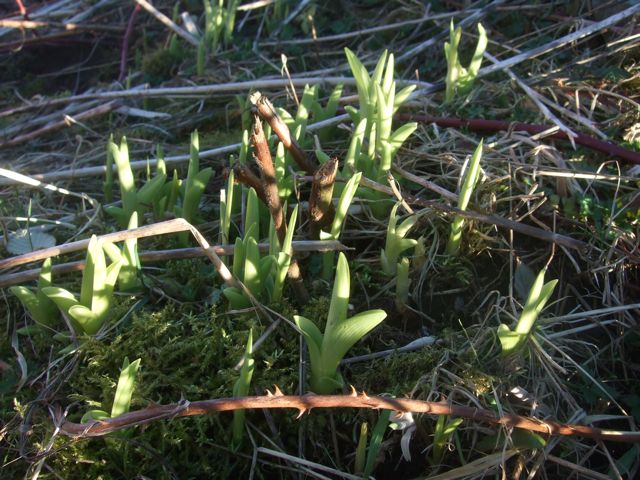
The day lilies on the farm are up . . . within a week or so I think we'll be eating the shoots!

The lean-to cold frame is getting full with transplants. These are all onions and shallots on a heated table. The transplants come out here, where they get natural light, after the seeds have germinated and emerged.

This is what the floor of our indoor start room looks like at the moment. Kale, green onions, tomatoes, artichokes, celery, onions and leeks are germinating at the moment.

This note on a seed shipment from Johnny's Seeds (a US company) has me wondering. Is this a warning to the purchaser of what they can (and cannot do) or is it a note for customs to tell them that it's seed for growing, not resale? I'm going to call next week to find out.

Tuesday, February 15, 2011

Videos: Primers on joining a CSA

Here are two great videos about Community Supported Agriculture programs. In case you're thinking about joining ours, we think these represent our philosophy and the nature of our CSA.